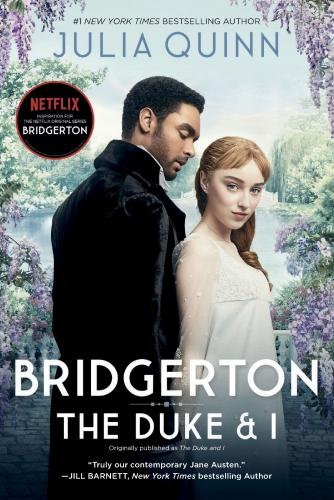
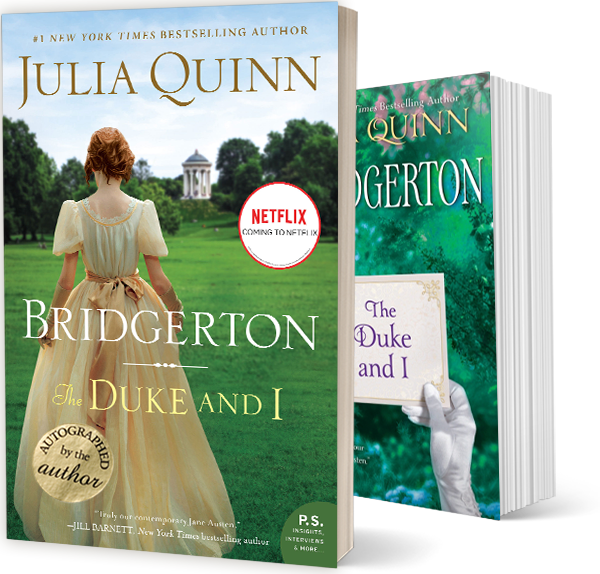
Can there be any greater challenge to London’s Ambitious Mamas than an unmarried duke?
Lady Whistledown’s Society Papers,
April 1813
By all accounts, Simon Basset is on the verge of proposing to his best friend’s sister, the lovely—and almost-on-the-shelf—Daphne Bridgerton. But the two of them know the truth—it’s all an elaborate plan to keep Simon free from marriage-minded society mothers. And as for Daphne, surely she will attract some worthy suitors now that it seems a duke has declared her desirable.
But as Daphne waltzes across ballroom after ballroom with Simon, it’s hard to remember that their courtship is a complete sham. Maybe it’s his devilish smile, certainly it’s the way his eyes seem to burn every time he looks at her… but somehow Daphne is falling for the dashing duke… for real! And now she must do the impossible and convince the handsome rogue that their clever little scheme deserves a slight alteration, and that nothing makes quite as much sense as falling in love…
"Men are sheep. Where one goes the rest will soon follow"
Inside the Story:
JQ’s Author Notes
Of all my books, The Duke and I was the most difficult to title. I have a personal fondness for Daphne's Bad Heir Day, but How to Bear an Heir was also a contender for the "Most Fun Titles You Never Used" award.
Eagle-eyed readers will spot a few of my favorite past characters in the pages of The Duke and I. The heroes from both Everything and the Moon and How to Marry a Marquis are mentioned in Chapter One (although neither actually says anything). And of course Lady Danbury is right there in the thick of it. She first appeared as a major secondary character in How to Marry a Marquis, and I liked her so much I thought it would be fun to bring her back. Little did I know that this would be the first of many, many Lady Danbury appearances. In fact, I think she might be my very favorite character to write.
Lady Whistledown's Society Papers, which made their debut in The Duke and I, came about almost by accident. I was writing the opening scene, and I realized that I needed to impart quite a bit of expository information. I wanted the reader to know that Daphne was from a large family and that she was fourth in the birth order, with three older brothers. I couldn't very well have Daphne and her mother mention all this in conversation, as this wasn't news to either one of them, so I came up with the idea of putting it all down in a gossip column. It turned out to be the most happy accident in my entire career!
Many people have asked me where I got the idea to have Simon stutter, and the truth is, I'm not sure. I have never stuttered, nor has anyone in my family. I did a fair amount of research into stuttering, but there really wasn't much to go on with regards to the regency era, so in the end I tried to simply imagine how frustrating it must have felt for someone as intelligent as Simon to be unable to communicate with as much facility as his peers.
Finally, while I was writing this book, someone very close to me was diagnosed with Multiple Sclerosis, and so I've decided to donate a portion of my royalties to the National Multiple Sclerosis Society. Scientists are getting closer to a cure every day, and in my book, that will be the greatest happy ending of all.
The birth of Simon Arthur Henry Fitzranulph Basset, Earl Clyvedon, was met with great celebration. Church bells rang for hours, champagne flowed freely through the gargantuan castle that the newborn would call home, and the entire village of Clyvedon quit work to partake of the feast and holiday ordered by the young earl’s father.
This, the baker said to the blacksmith, was no ordinary baby.
For Simon Arthur Henry Fitzranulph Basset would not spend his life as Earl Clyvedon. That was a mere courtesy title. Simon Arthur Henry Fitzranulph Basset — the baby who possessed more names than any baby could possibly need — was the heir to one of England’s oldest and richest dukedoms. And his father, the ninth Duke of Hastings, had waited years for this moment.
As he stood in the hall outside his wife’s confinement room, cradling the squalling infant, the duke’s heart burst with pride. Already several years past forty, he had watched his cronies — dukes and earls, all — beget heir after heir. Some had had to suffer through a few daughters before siring a precious son, but in the end, they’d all been assured that their lines would continue, that their blood would pass forward into the next generation of England’s elite.
But not the Duke of Hastings. Though his wife had managed to conceive five times in the fifteen years of their marriage, only twice had she carried to full term, and both of those infants had been stillborn. After the fifth pregnancy, which had ended with a bloody miscarriage in the fifth month, surgeons and physicians alike had warned their graces that they absolutely must not make another attempt to have a child. The duchess’s very life was in danger. She was too frail, too weak, and perhaps, they said gently, too old. The duke was simply going to have to reconcile himself to the fact that the dukedom would pass out of the Basset family.
But the duchess, God bless her, knew her role in life, and after a six-month recuperative period, she opened the connecting door between their bedrooms, and the duke once again commenced his quest for a son.
Five months later, the duchess informed the duke that she had conceived. The duke’s immediate elation was tempered by his grim determination that nothing —absolutely nothing— would cause this pregnancy to go awry. The duchess was confined to her bed the minute it was realized that she’d missed her monthly courses. A physician was brought in to visit her every day, and halfway through the pregnancy, the duke located the most respected doctor in London and paid him a king’s ransom to temporarily abandon his practice and take up residence at Clyvedon Castle.
The duke was taking no chances this time. He would have a son, and the dukedom would remain in Basset hands.
The duchess experienced pains a month early, and pillows were tucked under her hips. Gravity might keep the babe inside, Dr. Stubbs explained. The duke thought that a sound argument, and, when the doctor had retired for the evening, placed yet another pillow under his wife, raising her to a twenty degree angle. She remained that way for a month.
And then finally, the moment of truth arrived. The household prayed for the duke, who so wanted an heir, and a few remembered to pray for the duchess, who had grown thin and frail even as her belly had grown round and wide. They tried not to be too hopeful — after all, the duchess had already delivered and buried two babes. And even if she did manage to safely deliver a child, it could be, well, a girl.
As the duchess’s screams grew louder and more frequent, the duke shoved his way into her chamber, ignoring the protests of the doctor, the midwife, and her grace’s maid. It was a bloody mess, but the duke was determined to be present when the babe’s sex was revealed. The head appeared, then the shoulders.
All leaned forward to watch as the duchess strained and pushed, and then…
And then the duke knew that there was a God, and He smiled on the Bassets. He allowed the midwife one minute to clean the babe, then took the little boy into his arms and marched into the great hall to show him off.
“I have a son!” he boomed. “A perfect little son!”
And while the servants cheered and wept with relief, the duke looked down upon the tiny little earl and said, “You are perfect. You are a Basset. You are mine.”
The duke wanted to take the boy outside to prove to everyone that he had finally sired a healthy male child, but there was a slight chill in the early April air, so he allowed the midwife to take the babe back to his mother. The duke mounted one of his prized geldings and rode off to celebrate, shouting his good fortune to all who would listen.
Meanwhile, the duchess, who had been bleeding steadily since the birth, slipped into unconsciousness, and then finally just slipped away.
The duke mourned for his wife. He truly did. He hadn’t loved her, of course, and she hadn’t loved him, but they’d been friends in an oddly distant sort of way. The duke hadn’t expected anything more from marriage than a son and an heir, and in that regard, his wife had proven herself an exemplary spouse. He arranged for fresh flowers to be laid at the base of her funereal monument every week, no matter the season, and her portrait was moved from the sitting room to the hall, in a position of great honor over the staircase.
And then the duke got on to the business of raising his son.
There wasn’t much he could do in the first year, of course. The babe was too young for lectures on land management and responsibility, so the duke left Simon in the care of his nurse and went to London, where his life continued much as it had before he’d been blessed by parenthood, except that he forced everyone —even the king— to gaze upon the miniature he’d had painted of his son shortly after his birth.
The duke visited Clyvedon from time to time, then returned for good on Simon’s second birthday, ready to take the young lad’s education in hand. A pony had been purchased, a small gun had been selected for future use at the fox hunt, and tutors were engaged in every subject known to man.
“He’s too young for all that!” Nurse Hopkins exclaimed.
“Nonsense,” Hastings replied condescendingly. “Clearly, I don’t expect him to master any of this anytime soon, but it is never too early to begin a duke’s education.”
“He’s not a duke,” Nurse muttered.
“He will be.” Hastings turned his back on her and crouched down beside his son, who was building an asymmetrical castle with a set of blocks on the floor. The duke hadn’t been down to Clyvedon in several months, and was pleased with Simon’s growth. He was a sturdy, healthy young boy, with glossy brown hair and clear blue eyes.
“What are you building there, son?”
Simon smiled and pointed.
Hastings looked up at Nurse Hopkins. “Doesn’t he speak?”
She shook her head. “Not yet, your grace.”
The duke frowned. “He’s two. Shouldn’t he be speaking?”
“Some children take longer than others, your grace. He’s clearly a bright young boy.”
“Of course he’s bright. He’s a Basset.”
Nurse nodded. She always nodded when the duke talked about the superiority of the Basset blood. “Maybe,” she suggested, “he just doesn’t have anything he wants to say.”
The duke didn’t look convinced, but he handed Simon a toy soldier, patted him on the head, and left the house to go exercise the new mare he’d purchased from Lord Worth.
Two years later, however, he wasn’t so sanguine.
“Why isn’t he talking?” he boomed.
“I don’t know,” Nurse answered, wringing her hands.
“If you’d been doing your job correctly, he” —the duke jabbed an angry finger in Simon’s direction— “would be speaking.”
Simon, who was practicing his letters at his miniature desk, watched the exchange with interest.
“He’s four years old, God damn it,” the duke roared. “He should be able to talk.”
“He can write,” Nurse said quickly. “Five children I’ve raised, and not a one of them has taken to letters the way Master Simon has.”
“A fat lot of good writing is going to do him if he can’t talk.” Hastings turned to Simon, rage burning in his eyes. “Talk to me, damn you!”
Simon shrank back, his lower lip quivering.
“Your grace!” Nurse exclaimed. “You’re scaring the child.”
Hastings whipped around to face her. “Maybe he needs scaring. Maybe what he needs is a good dose of discipline. A good paddling might help him find his voice.”
The duke grabbed the silver-backed brush Nurse used on Simon’s hair and advanced on his son. “I’ll make you talk, you stupid little—”
“No!”
Nurse gasped.The duke dropped the brush. It was the first time they’d ever heard Simon’s voice.
“What did you say?” the duke whispered, tears forming in his eyes.
Simon’s fists balled at his sides, and his little chin jutted out as he said, “Don’t you h-h-h-h-h-h-h—”
The duke’s face turned deathly pale. “What is he saying?”
Simon attempted the sentence again. “D-d-d-d-d-d-d—”
“My God,” the duke breathed, horrified. “He’s a moron.”
“He’s not a moron!” Nurse cried out, throwing her arms around the boy.
“D-d-d-d-d-d-d-don’t you h-h-h-h-h-h-hit” —Simon took a deep breath— “me.”
Hastings sank onto the window seat. “What have I done to deserve this? What could I have possibly done…”
“You should be giving the boy praise!” Nurse Hopkins admonished. “Four years you’ve been waiting for him to speak, and—”
“And he’s an idiot!” Hastings roared. “A goddamned, bloody little idiot!”
“Hastings is going to go to a half-wit,” the duke moaned. “All those years of praying for an heir, and now it’s all for ruin. I should have let the title go to my cousin.” He turned back to his son, who was sniffling and wiping his eyes, trying to appear strong for his father. “I can’t even look at him,” he gasped. “I can’t even bear to look at him.”
And with that, the duke stalked out of the room. Nurse Hopkins hugged the boy close. “You’re not an idiot,” she whispered fiercely. “You’re the smartest little boy I know. And if anyone can learn to talk properly, I know it’s you.”
Simon turned into her warm embrace and sobbed.
“We’ll show him,” Nurse vowed. “He’ll eat his words if it’s the last thing I do.”
Nurse Hopkins proved true to her word. While the Duke of Hastings removed himself to London and tried to pretend he had no son, she spent every waking minute with Simon, sounding out words and syllables, praising him lavishly when he got something right, and giving him encouraging words when he didn’t.
The progress was slow, but Simon’s speech did improve. By the time he was six, “d-d-d-d-d-d-d-don’t” had turned into “d-d-don’t,” and by the time he was eight, he was managing entire sentences without faltering. He still ran into trouble when he was upset, and Nurse had to remind him often that he needed to remain calm and collected if he wanted to get the words out in one piece.
But Simon was determined, and Simon was smart, and perhaps most importantly, he was damned stubborn. He learned to take breaths before each sentence, and to think about his words before he attempted to say them. He studied the feel of his mouth when he spoke correctly, and tried to analyze what went wrong when he didn’t.
And finally, at the age of eleven, he turned to Nurse Hopkins, paused to collect his thoughts, and said, “I think it is time we went to see my father.”
Nurse looked up sharply. The duke had not laid eyes on the boy in seven years. “Are you certain?”
Simon nodded.
“Very well, then. I’ll order the carriage. We’ll leave for London on the morrow.”
The trip took much of the day, and it was late afternoon by the time their carriage rolled up to Basset House. Simon gazed at the busy London streetscape with wonder as Nurse Hopkins led him up the steps. Neither had ever visited Basset House before, and so Nurse didn’t know what to do when she reached the front door other than knock.
The door swung open within seconds, and they found themselves being looked down upon by a rather imposing butler.
“Deliveries,” he intoned, reaching to close the door, “are made in the rear.”
“Hold there!” Nurse said quickly, jamming her foot in the door. “We are not servants.”
The butler looked disdainfully at her garments.
“Well, I am, but not him.” She grabbed Simon’s arm and yanked him forward. “This is Earl Clyvedon, and you’d do well to treat him with respect.”
The butler’s mouth actually dropped open, and he blinked several times before saying, “It is my understanding that Earl Clyvedon is dead.”
“What?” Nurse screeched.
“I most certainly am not!” Simon exclaimed, with all the righteous indignation of an eleven-year-old.
The butler examined Simon, recognized immediately that he had the look of the Bassets, and ushered them in. “Why did you think I was d-dead?” Simon asked, cursing himself for misspeaking, but not surprised. He was most likely to stutter when he was angry.
“It most certainly is,” Nurse shot back. “You can’t say something like that to a boy of his years and not explain it.”
The butler was silent for a moment, then finally said, “His grace has not mentioned you in years. The last I heard, he said he had no son. He looked quite pained as he said it, so no one pursued the conversation. We all —the servants, that is— assumed you’d passed on.”
Simon felt his jaw clench, felt his throat working wildly. “Wouldn’t he have gone into mourning?” Nurse demanded. “Did you think about that? How could you have assumed the boy was dead if his father were not in mourning?”
The butler shrugged. “His grace frequently wears black. Mourning wouldn’t have altered his costume.”
“This is an outrage,” Nurse said. “I demand you summon his grace at once.”
Simon said nothing. He was trying too hard to get his emotions under control. He had to. There was no way he’d be able to talk with his father while his blood was racing so.
The butler nodded. “He is upstairs. I’ll alert him immediately to your arrival.”
Nurse started pacing wildly, muttering under her breath and referring to his grace with every vile word in her vocabulary. Simon remained in the center of the room, his arms angry sticks at his side as he took deep breaths. You can do this, he shouted in his mind. You can do this. Nurse turned to him, saw him trying to control his temper and immediately gasped. “Yes, that’s it,” she said quickly, dropping to her knees and taking her hands in his. “Take deep breaths. And make sure to think before you speak. If you can control—”
“I see you’re still mollycoddling the boy,” came an imperious voice from the doorway.
Nurse Hopkins straightened and turned slowly around. She tried to think of something respectful to say. She tried to think of anything that would smooth over this awful situation. But when she looked at the duke, she saw Simon in him, and her rage began anew. The duke might look just like his son, but he was certainly no father to him.
“You, sir,” she spat out, “are despicable.”
“And you, madam, are fired.”
Nurse lurched back.
“No one speaks to the Duke of Hastings that way,” he roared. “No one!”
“Not even the king?” Simon taunted.
Hastings whirled around, not even noticing that his son had spoken clearly.
“You,” he said in a low voice. Simon nodded curtly. He’d managed one sentence properly, but he didn’t want to push his luck. Not when he was this upset. Normally, he could go days without a stutter, but now…
The way his father stared at him made him feel like an infant. An idiot infant.
And his tongue suddenly felt awkward and thick.
The duke smiled cruelly. “What do you have to say for yourself, boy? Eh? What do you have to say?”
“It’s all right, Simon,” Nurse Hopkins whispered. “You can do it, sweetling.”
And somehow her encouraging tone made it all the worse. Simon had come here to prove himself to his father, and now his nurse was treating him like a baby.
“What’s the matter?” the duke taunted. “Cat got your tongue?”
Simon’s muscles clenched so hard he started to shake.
Father and son stared at each other for what felt like an eternity, until finally the duke swore and stalked toward the door. “Get him out of my sight,” he spat at Nurse Hopkins. “You can keep your job just so long as you keep him away from me.”
“Wait!”
The duke turned slowly around at the sound of Simon’s voice. “Did you say something?” he drawled.
Simon took three long breaths in through his nose, his mouth still clamped together in anger. He forced his jaw to relax and rubbed his tongue against the roof of his mouth, trying to remind himself of how it felt to speak properly. Finally, just as the duke was about to dismiss him again, he opened his mouth and said, “I am your son.”
Simon heard Nurse Hopkins breathe a sigh of relief, and something he’d never seen before blossomed in his father’s eyes. Pride. Not much of it, but there was something there, lurking in the depths; something that gave Simon a whisper of hope.
“I am your son,” he said again, this time a little louder, “and I am not d—”
Suddenly his throat closed up. And Simon panicked.
You can do this. You can do this.
But his throat felt tight, and his tongue felt thick, and his father’s eyes started to narrow…
“I am not d-d-d—”
“Go home,” the duke said in a low voice. “There is no place for you here.”
Simon felt the duke’s rejection in his very bones, felt a peculiar kind of pain enter his body and creep around his heart. And as hatred flooded his body and poured from his eyes, he made a solemn vow.
If he couldn’t be the son his father wanted, then by God, he’d be the exact opposite…
Chapter One
The Bridgertons are by far the most prolific family in the upper echelons of society. Such industriousness on the part of the viscountess and the late viscount is commendable, although one can find only banality in their choice of names for their children. Anthony, Benedict, Colin, Daphne, Eloise, Francesca, Gregory, and Hyacinth — orderliness is, of course, beneficial in all things, but one would think that intelligent parents would be able to keep their children straight without needing to alphabetize their names.
Furthermore, the sight of the viscountess and all eight of her children in one room is enough to make one fear one is seeing double — or triple — or worse. Never has This Author seen a collection of siblings so ludicrously alike in their physical regard. Although this Author has never taken the time to record eye color, all eight possess similar bone structure and the same thick, chestnut hair. One must pity the viscountess as she seeks advantageous marriages for her brood that she did not produce a single child of more fashionable coloring. Still, there are advantages to a family of such consistent looks — there can be no doubt that all eight are of legitimate parentage.
Ah, Gentle Reader, your devoted Author wishes that that were the case amid all large families…
Lady Whistledown’s Society Papers,
28 June 1813
“Oooooooooohhhhhhhhhh!” Violet Bridgerton crumpled the single-page newspaper into a ball and hurled it across the elegant drawing room.
Her daughter Daphne wisely made no comment and pretended to be engrossed in her embroidery.
“Did you read what she said?” Violet demanded. “Did you?”
Daphne eyed the ball of paper, which now rested under a mahogany end table. “I didn’t have the opportunity before you, er, finished with it.”
“Read it, then,” Violet wailed, her arm slicing dramatically through the air. “Read how that woman has maligned us.”
Daphne calmly set down her embroidery and reached under the end table. She smoothed the sheet of paper out on her lap and read the paragraph about her family. Blinking, she looked up. “This isn’t so bad, Mother. In fact, it’s a veritable benediction compared to what she wrote about the Featheringtons last week.”
“How am I supposed to find you a husband while that woman is slandering your name?”
Daphne forced herself to exhale. After nearly two seasons in London, the mere mention of the word “husband” was enough to set her temples pounding. She wanted to marry, truly she did, and she wasn’t even holding out for a love match. But was it really too much to hope for a husband for whom one had at least some affection?
Thus far, four men had asked for her hand, but when Daphne had thought about living her days in their company, she just couldn’t do it. There were a number of men she thought might make reasonably good husbands, but the problem was — none of them was interested. Oh, they all liked her. Everyone liked her. Everyone thought she was funny and kind and a quick wit, and no one thought her the least bit unattractive, but at the same time, no one was dazzled by her beauty, stunned into speechlessness by her presence, or moved to write poetry in her honor.
Men, she thought with disgust, seemed interested only in those women who terrified them.
No one seemed inclined to court someone like her. They all adored her, or so they said, because she was so easy to talk to, and she always seemed to understand how a man felt. As one of the men Daphne had thought might make a reasonably good husband had said, “Deuce take it, Daff, you’re just not like regular females. You’re positively normal.”
Which she might have managed to consider a compliment if he hadn’t proceeded to wander off in search of the latest blond beauty.
Daphne looked down and noticed that her hand was clenched into a fist. Then she looked up and realized her mother was staring at her, clearly waiting for her to say something. Since she had already exhaled, Daphne cleared her throat and said, “I’m sure Lady Whistledown’s little column is not going to hurt my chances for a husband.”
“Daphne, it’s been two years!”
Daphne’s fingernails bit her palm, as she willed herself not to make a retort. She knew her mother had only her best interests at heart, she knew her mother loved her. And she loved her mother, too. In fact, until Daphne had reached marriageable age, Violet had been positively the best of mothers. She still was, when she wasn’t despairing over the fact that after Daphne she had three more daughters to marry off.
Violet pressed a delicate hand to her chest. “She cast aspersions on your parentage.”
“No,” Daphne said slowly. It was always wise to proceed with caution when contradicting her mother. “Actually, what she said was that there could be no doubt that we are all legitimate. Which is more than one can say for most large families of the ton.”
“She shouldn’t have even brought it up,” Violet sniffed.
“Mother, she’s the author of a scandal sheet. It’s her job to bring such things up.”
“She isn’t even a real person,” Violet added angrily. She planted her hands on her slim hips, then changed her mind and shook her finger in the air. “Whistledown, ha! I’ve never heard of any Whistledowns. Whoever this depraved woman is, I doubt she’s one of us. As if anyone of breeding would write such wicked lies.”
“Of course she’s one of us,” Daphne said, her brown eyes filling with amusement. “If she weren’t a member of the ton, there is no way she’d privy to the sort of news she reports. Did you think she was some sort of impostor, peeking in windows and listening at doors?”
“I don’t like your tone, Daphne Bridgerton,” Violet said, her eyes narrowing.
Daphne bit back another smile. “I don’t like your tone,” was Violet’s standard answer when one of her children was winning an argument.
But it was too much fun to tease her mother. “I wouldn’t be surprised,” she said, cocking her head to the side, “if Lady Whistledown was one of your friends.”
“Bite your tongue, Daphne. No friend of mine would ever stoop so low.”
“Very well,” Daphne allowed, “it’s probably not one of your friends. But I’m certain it’s someone we know.”
Violet crossed her arms. “I should like to put her out of business once and for all.”
“If you wish to put her out of business,” Daphne could not resist pointing out, “you shouldn’t support her by buying her newspaper.”
“And what good would that do?” Violet demanded. “Everyone else is reading it. My puny little embargo would do nothing except make me look ignorant when everyone else is chuckling over her latest gossip.”
That much was true, Daphne silently agreed. London was positively addicted to Lady Whistledown’s Society Papers. The mysterious newspaper had arrived on the doorstep of every member of the ton three months earlier. For two weeks it was delivered unbidden every Monday, Wednesday, and Friday. And then, on the third Monday, butlers across London waited in vain for the pack of paperboys who normally delivered Whistledown, only to discover that instead of free delivery, they were selling the gossip sheet for the outrageous price of five pennies a paper.
Daphne had to admire the fictitious Lady Whistledown’s savvy. By the time she started forcing people to pay for their gossip, all the ton was addicted. Everyone forked over their pennies, and somewhere some meddlesome woman was getting rich.
While Violet paced the room and huffed about this “hideous slight” against her family, Daphne looked up to make certain her mother wasn’t paying her any attention, then let her eyes drop to peruse the rest of the scandal sheet. Whistledown —as it was now called— was a curious mix of commentary, social news, scathing insult, and the occasional compliment. What set it apart from any previous society news sheets was that the author actually listed her subjects’ names in full. There was no hiding behind abbreviations such as Lord S— and Lady G—. If Lady Whistledown wanted to write about someone, she used his full name. The ton declared themselves scandalized, but they were secretly fascinated.
Today’s edition was typical Whistledown. Aside from the short piece on the Bridgertons — which was really no more than a description of the family — Lady Whistledown had recounted the events at the previous night’s ball. Daphne hadn’t attended, as it had been her younger sister’s birthday, and the Bridgertons always made a big fuss about birthdays. And with eight children, there were a lot of birthdays to celebrate.
“You’re reading that rubbish,” Violet accused. Daphne looked up, refusing to feel the least bit guilty. “She gives quite a good account of the Middlethorpe ball. Mentions who was talking to whom, what everyone was wearing—”
“And I suppose she felt the need to editorialize on that point,” Violet cut in.
Daphne smiled wickedly. “Oh, come now, Mother. You know that Mrs. Featherington has always looked dreadful in purple.”
Violet tried not to smile. Daphne could see the corners of her mouth twitching as she tried to maintain the composure she deemed appropriate for a viscountess and mother. But within two seconds, she was grinning and sitting next to her daughter on the sofa. “Let me see that,” she said, snatching up the paper. “What else happened? Did we miss anything important?”
Daphne said, “Really, Mother, with Lady Whistledown as a reporter, one needn’t actually attend any events.” She waved toward the paper. “This is almost as good as actually being there. Better, probably. I’m certain we had better food last night than they did at the ball. And give that back.” She yanked the paper back, leaving a torn corner in Violet’s hands.
“Daphne!”
Daphne affected mock righteousness. “I was reading it.”
“Well!”
“Listen to this.”
Violet leaned in.
Daphne read: “‘The rake formerly known as Earl Clyvedon has finally seen fit to grace London with his presence. Although he has not yet deigned to make an appearance at a respectable evening function, the new Duke of Hastings has been spotted several times at White’s.’ ” She paused to take a breath. ” ‘His grace has resided abroad for six years. Can it be any coincidence that he has returned only now that the old duke is dead?’ ” Daphne looked up. “My goodness, she is blunt, isn’t she? Isn’t Clyvedon one of Anthony’s friends?”
“He’s Hastings now,” Violet said automatically, “and yes, I do believe he and Anthony were friendly at Oxford. And Eton as well, I think.” Her brow scrunched and her pale blue eyes narrowed with thought. “He was something of a hellion, if my memory serves. Always at odds with his father. But reputed to be quite brilliant. Anthony said he took a first in mathematics.”
“He sounds quite interesting,” Daphne murmured.
Violet looked at her sharply. “He’s quite unsuitable for a young lady of your years is what he is.”
“Funny how my ‘years,’ as you put it, volley back and forth between being so young that I cannot even meet Anthony’s friends and being so old that you despair of my ever contracting a good marriage.”
“—like my tone, I know.” Daphne grinned. “But you love me.”
Violet smiled warmly and wrapped an arm around Daphne’s shoulder. “Heaven help me, I do.”
Daphne gave her mother a quick peck on the cheek. “It’s the curse of motherhood. You’re required to love us even when we vex you.”
Violet just rolled her eyes. “I hope that someday you have children—”
“—just like me, I know.” Daphne rested her head on her mother’s shoulder. Her mother was a fussbudget, and her father had been more interested in hounds and hunting than he’d been in society affairs, but theirs had been a warm marriage, filled with love and laughter. “I could do a great deal worse than follow your example, Mother,” she murmured.
“Why Daphne,” Violet said, her eyes growing watery, “what a lovely thing to say.”
Daphne twirled a lock of her chestnut hair around her finger, and grinned, letting the sentimental moment melt into a more teasing one. “I’m happy to follow in your footsteps when it comes to marriage and children, Mother, just so long as I don’t have to have eight.”
At that exact moment, Simon Basset, the new Duke of Hastings and the erstwhile topic of the Bridgerton ladies’ conversation, was sitting at White’s. His companion was none other than Anthony Bridgerton, Daphne’s eldest brother. The two cut a striking pair, both tall and athletic, with thick dark hair. But where Anthony’s eyes were the same deep brown as his sister’s, Simon’s were icy blue, with an oddly penetrating gaze.
It was those eyes as much as anything that had earned him his reputation as a man to be reckoned with. When he stared at a person, clear and unwavering, men grew uncomfortable. Women positively shivered.
But not Anthony. The two men had known each other for years, and Anthony just laughed when Simon raised a brow and turned his icy gaze upon him. “You forget, I’ve seen you with your head being lowered into a chamberpot,” Anthony had once told him. “It’s been difficult to take you seriously ever since.”
To which Simon had replied, “Yes, but if I recall, you were the one holding me over that fragrant receptacle.”
“One of my proudest moments, to be sure. But you had your revenge the next night in the form of a dozen eels.”
Simon allowed himself a smile as he remembered both the incident and their subsequent conversation about it. Anthony was a good friend, just the sort a man would want by his side in a pinch. He’d been the first person he’d gotten in touch with upon returning to England.
“It’s damned fine to have you back, Clyvedon,” Anthony said once they’d settled in at their table at White’s. “Oh, but I suppose you’ll insist I call you Hastings now.”
“No,” Simon said rather emphatically. “Hastings will always be my father. He never answered to anything else.” He paused. “I’ll assume his title if I must, but I won’t be called by his name.”
“If you must?” Anthony’s brown eyes widened slightly. “Most men would not sound quite so resigned about the prospect of a dukedom.”
Simon raked a hand through his dark hair. He knew he was supposed to cherish his birthright and display unwavering pride in the Basset family’s illustrious history, but the truth was it all made him sick inside. He’d spent his entire life not living up to his father’s expectations; it seemed ridiculous now to try to live up to his name. “It’s a damned burden is what it is,” he finally said.
“You’d best get used to it,” Anthony said pragmatically, “because that’s what everyone will call you.”
Simon knew it was true, but he doubted if the title would ever sit well upon his shoulders.
“Well, whatever the case,” Anthony added, respecting his friend’s privacy by not delving further into what was obviously an uncomfortable topic, “I’m glad to have you back. I might finally get some peace next time I escort my sister to a ball.”
Simon leaned back, crossing his long legs at the ankles. “An intriguing remark.”
Anthony raised a brow. “One that you’re certain I’ll explain?”
“But of course.”
“I ought to let you learn for yourself, but then, I’ve never been a cruel man.”
Simon chuckled. “This coming from the man who dunked my head in a chamberpot?”
Anthony waved his hand dismissively. “I was young.”
“And now you’re a model of mature decorum and respectability?”
Anthony grinned. “Absolutely.”
“So tell me,” Simon drawled, “how, exactly, am I meant to make your existence that much more peaceful?”
“I assume you plan to take your place in society?”
“You assume incorrectly.”
“But you are planning to attend Lady Danbury’s ball this week,” Anthony said.
“Only because I am inexplicably fond of the old woman. She says what she means, and—” Simon’s eyes grew somewhat shuttered.
“And?” Anthony prompted.
Simon gave his head a little shake. “It’s nothing. Just that she was rather kind to me as a child. I spent a few school holidays at her house with Riverdale. Her nephew, you know.”
“Very well. So you have no intention of entering society. I’m impressed by your resolve. But allow me to warn you— even if you do not choose to attend the ton’s events, they will find you.”
Simon, who had chosen that moment to take a sip of his brandy, choked on the spirit at the look on Anthony’s face when he said, “they.” After a few moments of coughing and sputtering, he finally managed to say, “Who, pray tell, are ‘they?’ ”
Anthony shuddered. “Mothers.”
“Not having had one myself, I can’t say I grasp your point.”
“Society mothers, you dolt. Those dragons with daughters of marriageable age. You can run, but you’ll never manage to hide from them. And I should warn you, my own is the worst of the lot.”
“Good God. And here I thought Africa was dangerous.”
Anthony shot his friend a faintly pitying look. “They will hunt you down. And when they find you, you will find yourself trapped in conversation with a pale young lady all dressed in white who cannot converse on topics other than the weather, who received vouchers to Almacks, and hair ribbons.”
A look of amusement crossed Simon’s features. “I take it, then, that you have become something of an eligible gentleman during my time abroad?”
“Not out of any aspirations to the role on my part, I assure you. If it were up to me, I’d avoid society functions like the plague. But my sister made her bow last year, and I’m forced to escort her from time to time.”
“Daphne, you mean?”
Anthony looked up in surprise. “Did the two of you ever meet?”
“No,” Simon admitted, “but I remember her letters to you at school, and I knew she was fourth in the family, so she had to start with D, and—”
“Ah, yes,” Anthony said with a slight roll of his eyes, “the Bridgerton method of naming children. Guaranteed to make certain no one forgets who you are.” Simon laughed.
“It worked, didn’t it?”
“Say, Simon,” Anthony suddenly said, leaning forward, “I’ve promised my mother I’ll have dinner at the Bridgerton House later this week with the family. Why don’t you join me?”
Simon raised a dark brow. “Didn’t you just warn me about society mothers and debutante daughters?”
Anthony laughed. “I’ll put my mother on her best behavior, and don’t worry about Daff. She’s the exception that proves the rule. You’ll like her immensely.”
Simon narrowed his eyes. Was Anthony playing matchmaker? He couldn’t tell.
As if Anthony were reading his thoughts, he laughed. “Good God, you don’t think I’m trying to pair you off with Daphne, do you?”
Simon said nothing.
“You would never suit. You’re a bit too brooding for her tastes.”
Simon thought that an odd comment, but instead chose to ask, “Has she had any offers, then?”
“A few. I’ve let her refuse them all.”
“That’s rather indulgent of you.” Anthony shrugged. “Love is probably too much to hope for in a marriage these days, but I don’t see why she shouldn’t be happy with her husband. We’ve had offers from two men old enough to be her father, one who is a bit too high in the instep for our often boisterous clan, and then this week, one who was perfectly amiable, but a rather bit dim in the head.”
“Not many brothers would allow their sister such latitude,” Simon said quietly.
Anthony just shrugged again, as if he couldn’t imagine treating his sister in any other way. “She’s been a good sister to me. It’s the least I can do.”
“Even if it means escorting her to Almacks?” Simon said wickedly.
Anthony groaned. “Even then.”
“I’d console you by pointing out that this will all be over soon, but you’ve what, three other sisters waiting in the wings?”
Anthony positively slumped in his seat. “Eloise is due out next year, and Francesca the year after that, but then I’ve a bit of a reprieve before Hyacinth comes of age.”
Simon chuckled. “I don’t envy you your responsibilities in that quarter.” But even as he said the words, he felt a strange longing, and he wondered what it would be like to be not quite so alone in this world. He had no plans to start a family of his own, but maybe if he’d had one to begin with, his life would have turned out a bit differently.
“So you’ll come for supper, then?” Anthony stood. “Informal, of course. We never take meals formally when it’s just family.”
Simon had a dozen things to do in the next few days, but before he could remind himself that he needed to get his affairs in order, he heard himself saying, “I’d be delighted.”
Not ready to order yours? Check out this story's
overview.
Read the excerpt. Listen to a bit on audio. Find
out
more about the
series. There’s so much to love!
As an Amazon Associate I earn from
qualifying
purchases. I also may use affiliate links elsewhere in
my site.
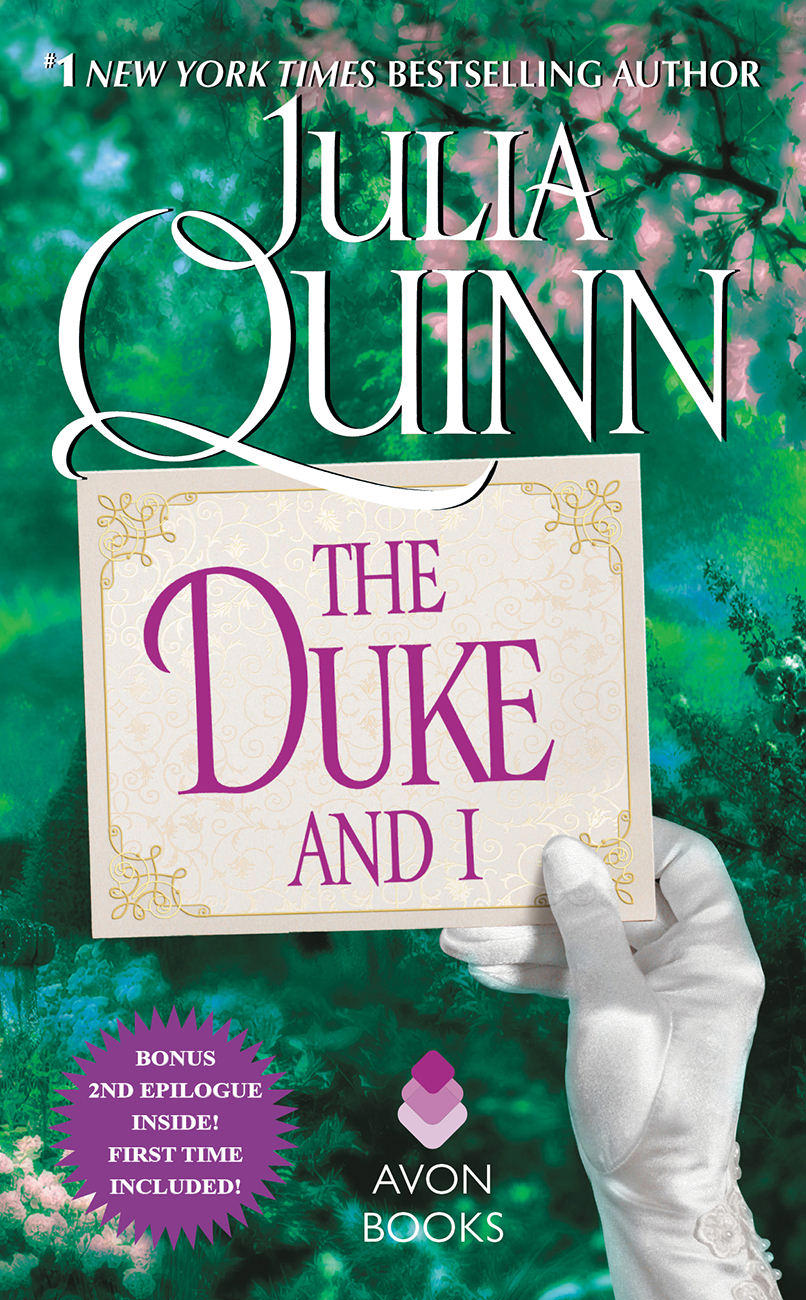
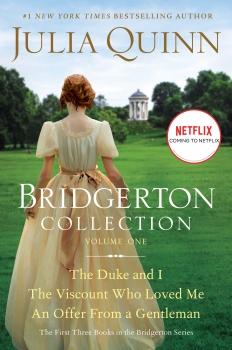
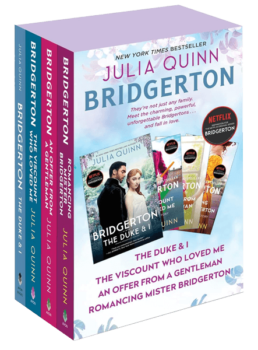
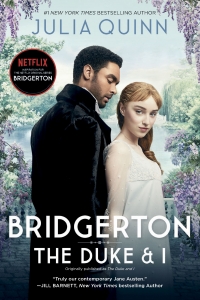
In 2021, following the premiere of Bridgerton on Netflix, The Duke and I shot to the top of every major bestseller list in the United States... and stayed there for months. It was also a Sunday Times bestseller in the UK, a Spiegel bestseller in Germany, a Dymocks bestseller in Australia, and a Veja bestseller in Brazil.
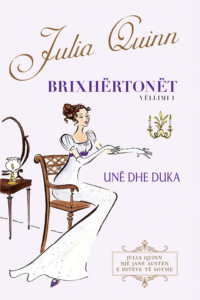
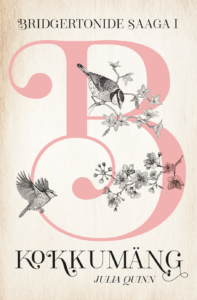
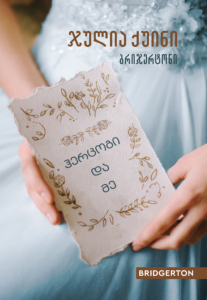
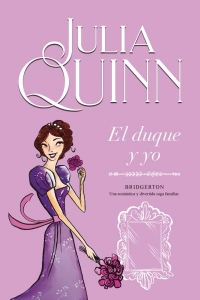
The Duke and I has become one of the most widely translated books in history. As of April 2021, it had been or was slated to be translated into 39 languages, including Albanian, Estonian, and Sinhala.
At the time of its release in 2000, The Duke and I spent three weeks on the New York Times Extended Bestseller list, two weeks on the Publishers Weekly Bestseller list, and five on the USA Today bestseller list.
The Duke and I was a finalist in the 2001 RITA Awards in the Short Historical category. The RITAs are awarded by Romance Writers of America and are the highest honor in romance writing. The eventual winner was The Mistressby Susan Wiggs.
The Duke and I was named one of the Ten Best Romances of 2000 by the editors at Amazon.com.
We use cookies on our website to give you the most relevant experience by remembering your preferences and repeat visits. By clicking “Accept”, you consent to the use of ALL the cookies. However you may visit Cookie Settings to provide a controlled consent.
This website uses cookies to improve your experience while you navigate through the website. Out of these, the cookies that are categorized as necessary are stored on your browser as they are essential for the working of basic functionalities of the website. We also use third-party cookies that help us analyze and understand how you use this website. These cookies will be stored in your browser only with your consent. You also have the option to opt-out of these cookies. But opting out of some of these cookies may affect your browsing experience.
Advertisement cookies are used to provide visitors with relevant ads and marketing campaigns. These cookies track visitors across websites and collect information to provide customized ads.
Cookie
Duration
Description
ccsid
20 years
No description available.
IDE
2 years
Used by Google DoubleClick and stores information about how the user uses the website and any other advertisement before visiting the website. This is used to present users with ads that are relevant to them according to the user profile.
NID
6 months
This cookie is used to a profile based on user's interest and display personalized ads to the users.
rur
The cookie is set by instagram to enable the user to browse through the website securely by preventing any cross-site request forgery.
S
1 hour
VISITOR_INFO1_LIVE
5 months
This cookie is set by Youtube. Used to track the information of the embedded YouTube videos on a website.
YSC
This cookies is set by Youtube and is used to track the views of embedded videos.
yt-remote-connected-devices
never
YouTube sets this cookie to store the video preferences of the user using embedded YouTube video.
yt-remote-device-id
never
YouTube sets this cookie to store the video preferences of the user using embedded YouTube video.
yt.innertube::nextId
never
This cookie, set by YouTube, registers a unique ID to store data on what videos from YouTube the user has seen.
yt.innertube::requests
never
This cookie, set by YouTube, registers a unique ID to store data on what videos from YouTube the user has seen.
Analytical cookies are used to understand how visitors interact with the website. These cookies help provide information on metrics the number of visitors, bounce rate, traffic source, etc.
Cookie
Duration
Description
CONSENT
2 years
YouTube sets this cookie via embedded youtube-videos and registers anonymous statistical data.
cookielawinfo-checkbox-functional
11 months
cookielawinfo-checkbox-uncategorized
11 months
csid
20 years
GPS
30 minutes
This cookie is set by Youtube and registers a unique ID for tracking users based on their geographical location
lobpc
10 years
locale
Facebook sets this cookie to enhance the user's browsing experience on the website, and to provide the user with relevant advertising while using Facebook’s social media platforms.
mo_has_visited
11 years
This cookie is used for setting an unique ID for the visitor which helps to get the accurate number of specific visitor on the website.
mo_is_new
session
This cookie is used for counting the new visitors to the website by assigning a unique visitor ID.
mo_page_views_counter
session
This cookie is used for counting the new visitors to the website by assigning a unique visitor ID.
urlgen
The cookie is set by instagram to enable the user to browse through the website securely by preventing any cross-site request forgery.
_ga
2 years
This cookie is installed by Google Analytics. The cookie is used to calculate visitor, session, camapign data and keep track of site usage for the site's analytics report. The cookies store information anonymously and assigns a randoly generated number to identify unique visitors.
_gat
1 minute
This cookies is installed by Google Universal Analytics to throttle the request rate to limit the colllection of data on high traffic sites.
_gid
1 day
This cookie is installed by Google Analytics. The cookie is used to store information of how visitors use a website and helps in creating an analytics report of how the wbsite is doing. The data collected including the number visitors, the source where they have come from, and the pages viisted in an anonymous form.




 Start Reading Now






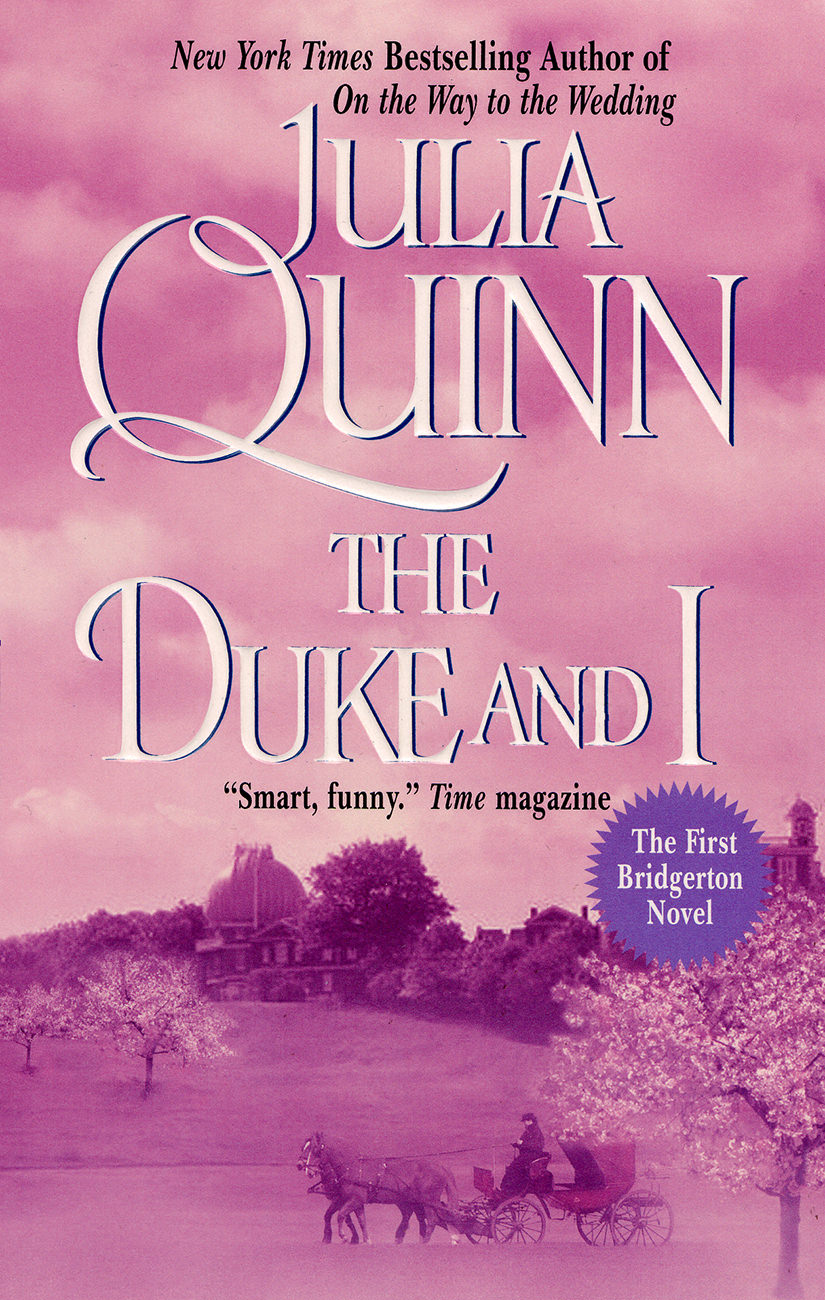
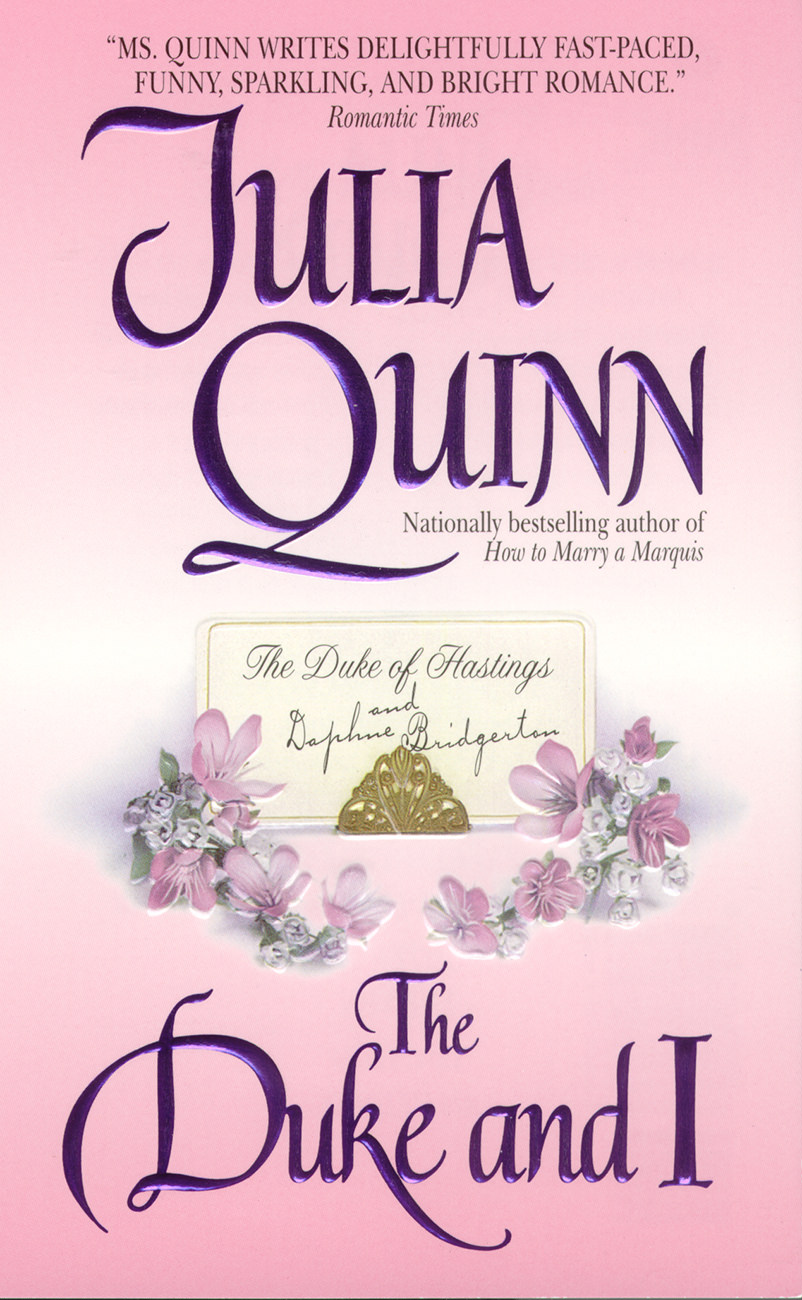
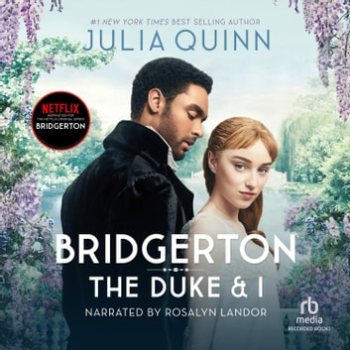

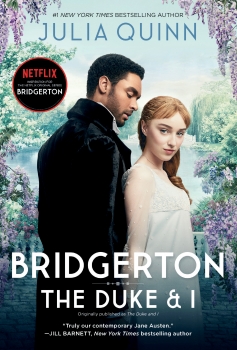
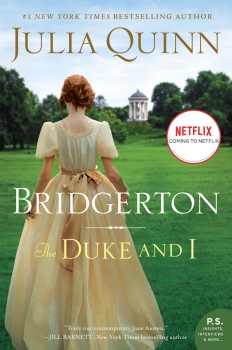
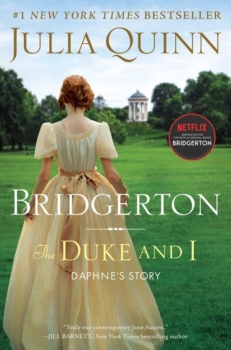
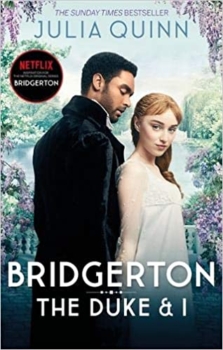



 At the time of its release in 2000, The Duke and I spent three weeks on the New York Times Extended Bestseller list, two weeks on the Publishers Weekly Bestseller list, and five on the USA Today bestseller list.
  The Duke and I was a finalist in the 2001 RITA Awards in the Short Historical category. The RITAs are awarded by Romance Writers of America and are the highest honor in romance writing. The eventual winner was The Mistress by Susan Wiggs.